

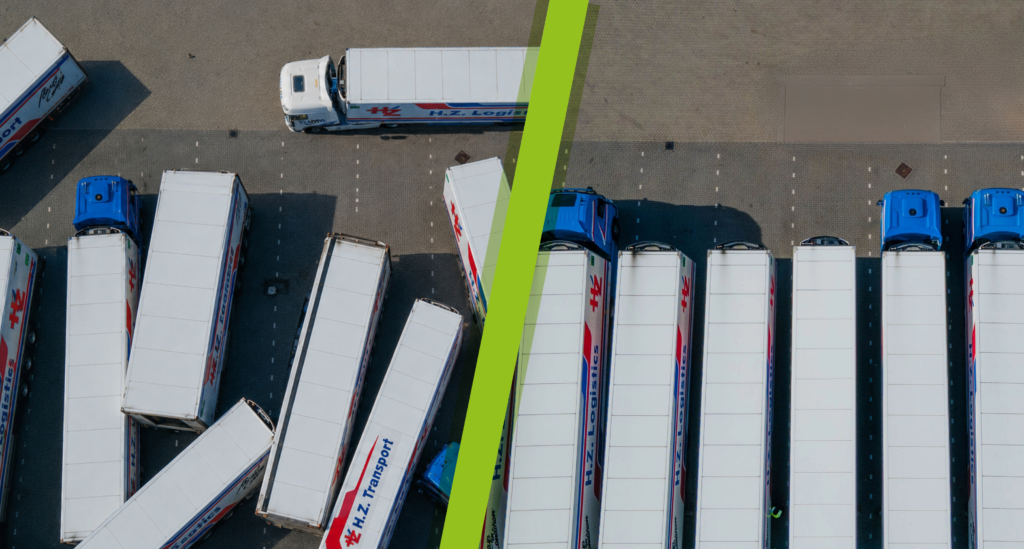
The yard is where plans collide with reality. Live and drop trailers stack up at the gate and door turns fluctuate hour by hour. Operators all chase the same question: “Where is everything right now, and what needs to move next?”
This hypothetical case study shows how a yard management system can transform a chaotic yard in just two weeks. Using YMSlite as an example, we’ll walk through the key steps that help the team gain real-time trailer visibility, establish structured workflows, and create a more predictable yard operation.
The results in this case study are illustrative. Every yard operates differently, so actual improvements depend on your processes, operational challenges, and KPIs.
Why Yard Chaos Happens
Our fictional company operates a small-to-mid-sized 3PL warehouse that handles live and drop trailers for multiple customers. On paper, everything looks under control. In reality, daily yard operations tell a different story.
During peak hours, trucks queue at the gate while teams search for trailers or move equipment multiple times because the yard lacks structure. Planners rely on spreadsheets, phone calls, and experience instead of real-time visibility. As priorities change throughout the day, operations quickly become reactive. The impact reaches the dock. Trailers arrive late, dock doors sit idle, and labor plans constantly change. Managers also struggle to track trailer status, dwell time, or customer performance without reliable yard data.
The problem isn’t a lack of people or capacity. The warehouse simply has no yard management system to connect gate, yard, and dock operations.
Baseline KPIs Before YMSlite
To understand the challenges, the warehouse first measures a few key performance indicators. In this example, the site handles 120–180 trailers per day, operates 18 dock doors and 85 yard parking spaces, and manages a mix of 40% live and 60% drop trailers.
- Average trailer dwell time: 2.8 days, with 22% of trailers staying longer than five days.
- Gate-to-gate cycle time: 70–160 minutes, depending on yard congestion.
- On-time dock arrivals: 68%, well below the 90% target.
- Door turns: 5.8 per dock per day, compared to a target of 7.
- Unplanned yard moves: 27% of all trailer movements.
- Drop trailer imbalance: Customer trailer pools fluctuate by 8–15 trailers, causing unnecessary repositioning and delays.
- Manual status requests: Around 45 yard checks and 70 trailer status calls or emails every shift.
None of these numbers looks alarming on its own. Together, they reveal a yard that spends too much time searching, reacting, and coordinating instead of moving trailers efficiently.
Why a Yard Management System Is Crucial for 3PL Warehouse Operations
The current toolset, along with partial data from the TMS and WMS, was never designed to manage this level of complexity. The WMS handles inventory, orders, and dock workload but not trailer status across every yard spot. The TMS manages tenders, appointments, and linehaul but not how live and drop equipment is staged or sequenced on the property. The yard itself runs on experience and tribal knowledge.
What the 3PL needs is a yard management system for 3PL operations that can sit alongside the WMS and TMS and provide:
- A real-time, shared view of trailer status across gate, yard, and dock.
- A system‑driven move queue that sequences yard moves based on time, priority, and rules.
- Clean, yard‑centric KPIs like dwell, gate‑to‑gate, door turns, and drop pool balance by customer and carrier.
They also know they cannot afford a long, heavy implementation. They need something that can be deployed quickly, with minimal IT effort and a learning curve frontline teams can handle while still running the operation. This is where YMSlite enters the conversation.
Introducing YMSlite: Fast-Track Yard Management for SMB 3PLs
YMSlite gives 3PL warehouses the tools to simplify and streamline yard operations. Instead of a long, heavily customized rollout, it is designed to be configured in 30 minutes.
In this scenario, the 3PL selects YMSlite because it offers:
- Cloud‑based deployment, avoiding heavy local infrastructure.
- A straightforward way to define yard locations, zones, doors, and trailer types.
- Role‑based views for gate clerks, yard drivers, and dock leads.
- A real-time trailer status model that distinguishes live, drop, empty, loaded, and ready.
The goal is not to redesign the operation overnight, but to give the yard a single source of truth and a system‑driven move engine that can be up and running in weeks.
Implementation Timeline: From Chaos to Control in 2 Weeks
Every site is different, but in this case we assume a compressed, two‑week implementation.
Week 1: Mapping the Yard and Standardizing Workflows
During the first few days, the team sets up YMSlite by creating docks, parking locations, trailer types, and other operational data. At the same time, the yard manager documents and simplifies gate, yard, and dock processes to establish a consistent way of working.
By the end of Week 1, the yard structure exists digitally, and the team has a clear view of how YMSlite will support gate check‑in/check‑out, trailer spotting, and door assignments.
Week 1: Training Core Users
In parallel, a focused group of core users. Gate clerks, yard drivers, and dock leads receive short, practical training sessions totaling roughly 6 hours. 2 hours for the gate, 2 hours yard moves & trailer status, and 2 hours dock workflows, dashboards and exception handling. The emphasis is on capturing clean trailer data at the gate, updating status as moves occur, and using system views instead of verbal updates and personal notes.
The aim is not to make everyone a power user; it is to ensure that the right people know how to keep the data clean and the move queue accurate from day one.
Week 2: Go‑Live and Stabilization
Week 2 is the controlled go‑live. The site may start with a single shift or a subset of doors, then ramp quickly once confidence builds.
By the second week, operators use YMSlite to keep track of every trailer on site and quickly locate parked equipment. They prioritize the next moves, coordinate dock assignments more efficiently, and immediately see where bottlenecks are forming. As questions or minor issues arise, the team fine-tunes the configuration and coaches users to ensure a smooth rollout. By the end of week 2, the yard team no longer needs to ask, “Where is trailer XY?”, they can see it, along with its status and priority, in real time.
Imagining This Scenario in Your Own Yard
Wondering how much your Yard would benefit from a YMS? To translate the case study into your own environment, try our free ROI-calculator.
If you were to plug your yard KPIs into our calculator, you would start with a short list:
- Average trailer dwell time on site.
- Gate‑to‑gate cycle time for live loads and unloads.
- Appointment adherence to “on‑time to door.”
- Door turns per dock per day.
- Percent of unplanned or corrective yard moves.
- Variability in drop pool levels by customer.
- Volume of “where is my trailer?” communications per shift.
Once you have those baseline metrics, you can ask a simple question: If a yard management system for 3PL operations like YMSlite moved each of these by a realistic amount, what would that mean in labor hours, carrier performance, and customer satisfaction? That is how this hypothetical two‑week transformation becomes a concrete business case.
Next Steps: See YMSlite in Action
If you recognize your operation in this scenario, the next move is simple.
Book a free YMSlite demo. Bring your own yard KPIs and see how they could look inside a yard management system designed specifically for 3PL operations. In the demo, you can walk through how quickly YMSlite can map your yard, structure your workflows, and start reducing chaos in a matter of weeks.
As a follow‑up, you can also watch our webinar on “Managing Labor and Volume Imbalances in Dock Operations.” It explores how better yard and dock visibility supports smarter labor planning, smoother volume swings, and more stable service levels.
Together, a targeted demo of YMSlite and the dock operations webinar give you a clear view of how your yard could move from reactive chaos to measurable control without long, heavy implementation.