

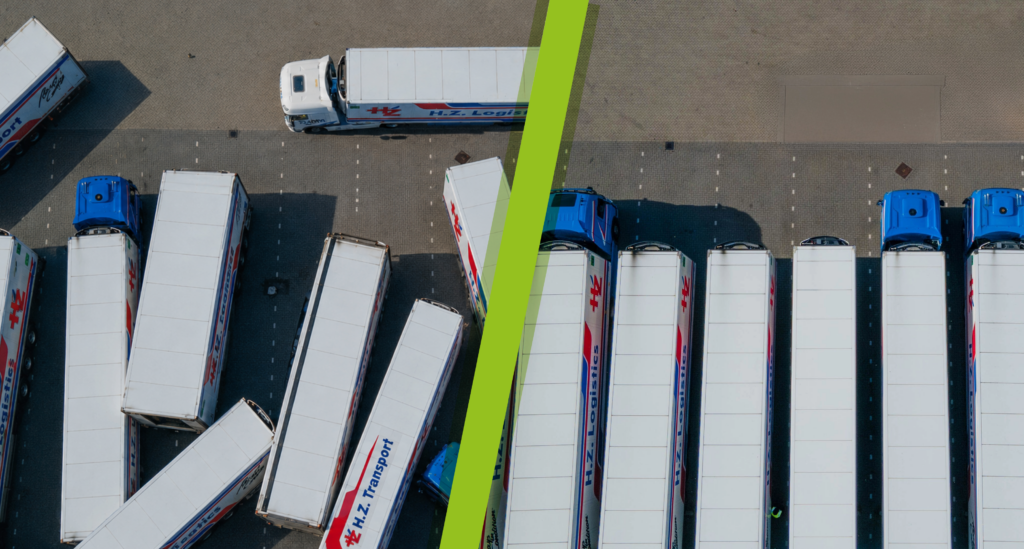
What happens when a busy 3PL warehouse implements a yard management system for warehouse operations instead of relying on spreadsheets and manual coordination?
This hypothetical case study illustrates how a warehouse handling 120-180 trailers per day could improve trailer visibility, move prioritization, and operational control within one week using YMSlite. All metrics in this example are placeholders intended to help you evaluate how a similar approach could affect your own operation.
The Challenge
The warehouse manages a mix of live and drop trailers for multiple customers. Despite having sufficient dock capacity and yard space, teams frequently struggle to locate trailers, prioritize moves, and keep yard activities aligned with dock schedules.
Without a dedicated yard management system for warehouse operations, operators rely on spreadsheets, emails, phone calls, and personal experience to coordinate daily activities. As trailer volume increases, teams spend more time searching, re-staging equipment, and responding to exceptions.
As a result:
- Trailer dwell time increases
- Appointment adherence declines
- Door utilization becomes inconsistent
- Yard teams perform unnecessary corrective moves
- Operations managers lack reliable performance data
The operation needs greater visibility, structured move prioritization, and a single source of truth across the gate, yard, and dock.
Baseline KPIs
For this example, the facility manages 120-180 trailers per day across 18 dock doors and approximately 85 yard spots. Before implementing YMSlite, key performance indicators look as follows:
- Trailer dwell time: [2.8 days]
- Appointment adherence: [68%]
- Door turns: [5.8 per door per day]
- Unplanned yard moves: [27%]
- Yard-check requests per shift: [45]
- Trailer status inquiries per shift: [70]
While none of these metrics appears critical in isolation, together they indicate an operation that spends too much time coordinating manually instead of executing a structured plan.
Why YMSlite?
The warehouse already uses a WMS and TMS. However, neither system manages trailer locations, yard execution, or move prioritization. To close that gap, the operation implements YMSlite.
YMSlite provides:
- Real-time trailer visibility
- Prioritized move execution
- Centralized operational data
- Fast deployment without extensive IT involvement
Unlike traditional yard management systems, a Yard Manager can configure YMSlite in approximately 30 minutes and begin operational use within days.
Implementation Timeline: From Chaos to Control in 1 Week
Every operation is different, but this example assumes a typical YMSlite deployment completed within one week.
Day 1: Yard Setup and Configuration
Instead of launching a complex implementation project, the Yard Manager simply configures the operational structure in YMSlite. Gates, parking locations, dock doors, equipment types, inventory areas, and operational priorities can all be defined directly in the system. Thanks to the streamlined setup process, the yard is ready for use in approximately 30 minutes. Operators can then start working with real-time trailer visibility and standardized workflows almost immediately. By the end of the first day, operators already have a complete digital overview of the yard structure.
Day 2: User Training
Gate clerks, yard drivers, planners, and dock supervisors participate in focused training sessions covering:
- Gate check-in and check-out
- Trailer status management
- Yard moves
- Door assignments
- Dashboards and exception handling
Instead of spending days in classroom sessions, users learn the workflows required for daily operations. Most employees become comfortable with the system after only a few hours of hands-on training. The objective is simple: ensure that frontline teams maintain accurate data and follow a standardized move process from the start.
Days 3-5: Go-Live and Adoption
The operation begins using YMSlite in daily yard activities. Operators track trailer locations, update statuses, prioritize yard moves, and coordinate trailer-to-door assignments through a shared platform instead of relying on spreadsheets, radio calls, and manual tracking.
As data quality improves, planners gain better visibility into trailer priorities and yard conditions. Yard drivers spend less time searching for equipment, while gate and dock teams work from the same source of information. Teams resolve minor issues through targeted coaching and small configuration adjustments. As confidence grows, users increasingly rely on system-generated priorities instead of verbal instructions and ad hoc decisions.
End of Week 1: Operational Control
Wondering how much your yard could benefit from a YMS? To translate this case study into your own environment, start with a short list of KPIs:
- Average trailer dwell time
- Gate-to-gate cycle time
- On-time-to-door appointment performance
- Door turns per dock
- Percentage of corrective or unplanned moves
- Customer drop-pool variability
- Number of trailer-location inquiries per shift
Once you establish those baseline metrics, you can evaluate how improvements in visibility, move execution, and yard coordination would affect labor utilization, carrier performance, and customer satisfaction. That is how a hypothetical one-week transformation becomes a practical business case.
Next Steps: See YMSlite in Action
Wondering how much your Yard would benefit from a YMS? To translate the case study into your own environment, try our free ROI calculator.
Or Book a free YMSlite demo directly. Bring your own yard KPIs and see how they could look inside a yard management system designed specifically for 3PL operations. In the demo, you can walk through how quickly YMSlite can map your yard, structure your workflows, and start reducing chaos in a matter of weeks.